■ Researchers involved
Chang-Min Lee (dlc2048@snu.ac.kr)
Yoonho Na (yoonho94.na@gmail.com)
Kyuri Kim (kyurikim@snu.ac.kr)
■ Description
RPLab is dedicated to pioneering the next generation of Treatment Planning Systems (TPS) for advanced hadron therapy, including carbon-ion and neutron beams. By integrating AI-driven automation with high-performance computing, we aim to transcend the current limitations of radiation oncology, delivering unprecedented precision and personalized care for cancer patients.
1. AI-Driven Automated Segmentation
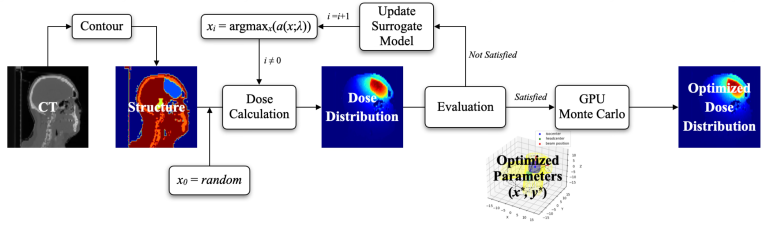
Precision in radiation therapy begins with an impeccable understanding of patient anatomy. We develop state-of-the-art deep learning architectures to automate the segmentation of tumors and organs-at-risk (OAR). Our technology minimizes inter-observer variability and drastically reduces contouring time, providing a robust foundation for seamless, real-time Adaptive Radiotherapy (ART).
2. GPU-Accelerated Monte Carlo Simulation
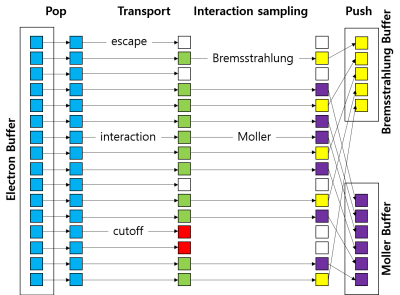
To ensure the highest level of dose calculation accuracy, we have engineered a world-first, GPU-accelerated Monte Carlo (MC) simulation engine. While traditional MC simulations are often too slow for clinical use, our engine harnesses massive parallel processing to deliver “gold-standard” accuracy within minutes. This breakthrough enables high-fidelity particle transport simulation, bridging the gap between sophisticated physics and rapid clinical workflows.
3. Intelligent Inverse Planning for Hadron Therapy
Optimizing the therapeutic ratio—maximizing tumor dose while strictly sparing healthy tissue—is the cornerstone of our inverse planning research. We have developed a first-of-its-kind inverse planning algorithm for neutron therapy that automatically determines optimal beam parameters based on complex clinical objectives. By incorporating radiobiological modeling into the optimization process, we ensure that every treatment plan is tailored to the unique biological characteristics of each patient.