■ Researchers involved
Manju Shrestha (manju.shrestha.n@gmail.com)
Junyoung Lee (xdrcftv@snu.ac.kr)
Mingi Eom (billowy552@snu.ac.kr)
Taewan Kim (jack970424@snu.ac.kr)
Jiwon Kim (jiwonkkim@snu.ac.kr)
Hwijoon Jeong (wjdgnlwns@snu.ac.kr)
■ Description
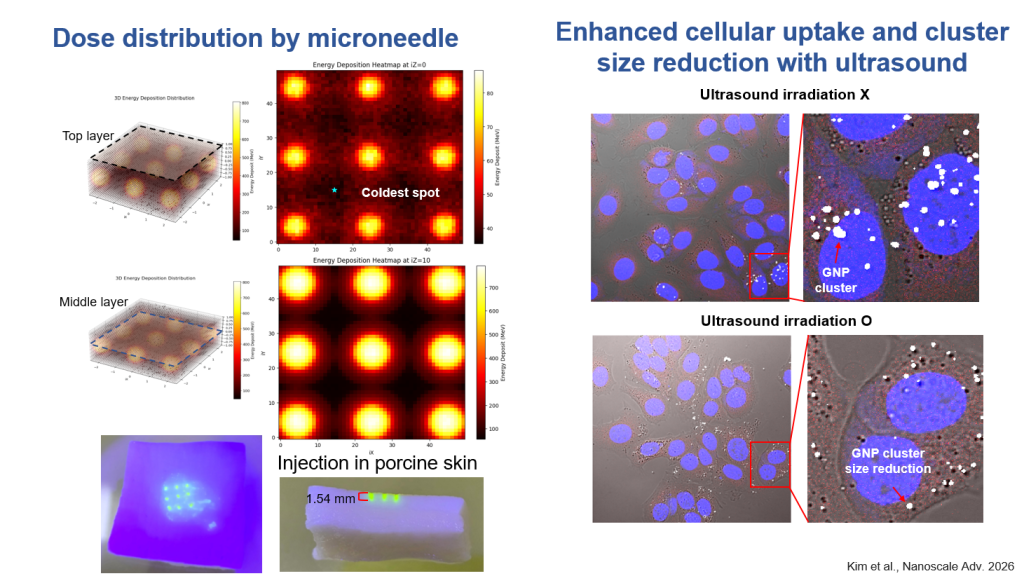
Despite major advances in radiotherapy and imaging technologies, improving patient survival while reducing normal-tissue toxicity remains a significant challenge for several cancers. In this context, nanoparticles (NPs), particularly gold nanoparticles (GNPs), have attracted considerable interest as both radiosensitizers and imaging probes. However, the clinical translation of GNP-mediated radiosensitization and imaging has remained limited, largely because their underlying physical and biological mechanisms are not yet fully understood. GNPs interact with ionizing radiation to enhance the localized production of secondary electrons, such as photoelectrons and Auger electrons, thereby showing dose enhancement around the particles.
Microdosimetry is the branch of radiation physics that characterizes the stochastic nature of energy deposition within microscopic volumes, such as cellular and sub-cellular structures. While conventional macrodosimetry focuses on the average absorbed dose over a large mass, microdosimetry accounts for the discrete and non-uniform distribution of energy, which is critical for predicting biological outcomes at the molecular level. Within this framework, RPLab focuses on investigating the synergistic effects between gold nanoparticles (GNPs) and external radiation, as well as the enhanced biological impact of radioisotopes, particularly those emitting high-LET Auger electrons. We aim to experimentally elucidate the mechanisms through which these modalities amplify biological damage and to develop predictive models for quantitative analysis. By integrating experimental data with computational modeling, our research seeks to provide a comprehensive understanding of how localized energy deposition leads to increased biological effectiveness.
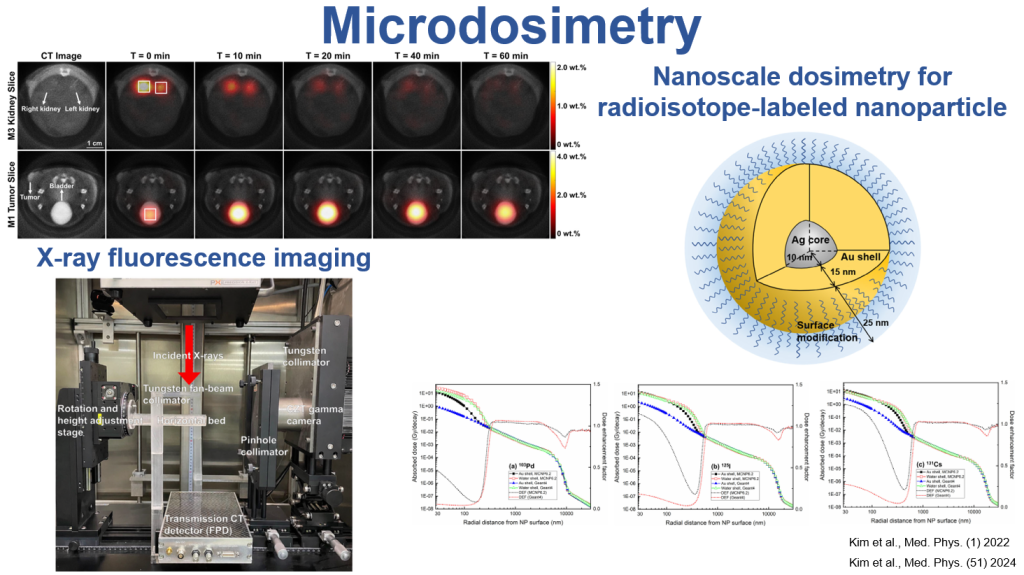
Our research investigates the fundamental mechanisms of GNP-mediated radiosensitization and imaging through an integrated approach combining computational simulations, microscale measurements, and experimental validation. We quantitatively evaluate GNP-mediated dose enhancement and distribution from a microdosimetric perspective using Monte Carlo simulations, including Geant4, MCNP, and Penelope, and support the development of biological models through in vitro cell experiments. In parallel, we develop dual-modality X-ray fluorescence/computed tomography (XRF/CT) imaging platforms based on a CZT detector, enabling simultaneous acquisition of functional information, such as GNP distribution and concentration, together with anatomical information from CT.