■ Description In radiological mass-casualty events, rapid retrospective dosimetry is essential for medical triage because many exposed individuals may not carry personal dosimeters. To address this need, our laboratory develops L-band in vivo electron paramagnetic resonance (EPR) tooth dosimetry, a rapid and non-invasive method for individual dose assessment. Conventional biodosimetry methods such as dicentric chromosome assay and blood-based biomarkers are valuable, but they can be time-consuming or less practical for emergency triage.
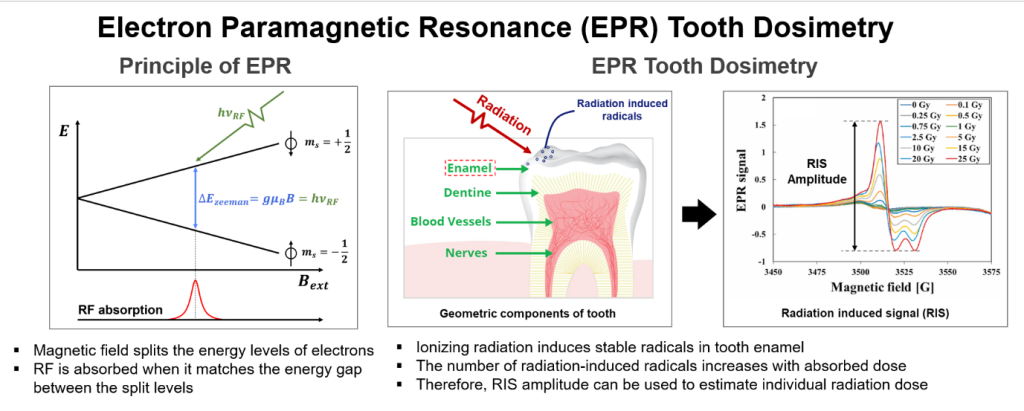
EPR spectroscopy specifically detects paramagnetic radicals in a sample. When a person is exposed to ionizing radiation, stable radiation-induced radicals are generated in tooth enamel. Because the amount of these radicals is proportional to the absorbed dose, the radiation-induced signal (RIS) measured by EPR can be used for retrospective dose estimation.
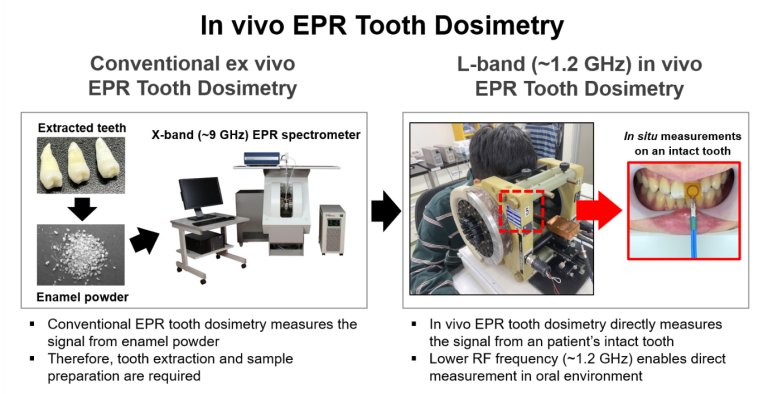
Conventional EPR tooth dosimetry generally relies on enamel powder from extracted teeth. In contrast, in vivo L-band EPR tooth dosimetry enables direct measurement from an intact tooth in situ by using lower-frequency microwaves that are suitable for the oral environment. This approach offers a practical route for rapid, non-destructive dose assessment.
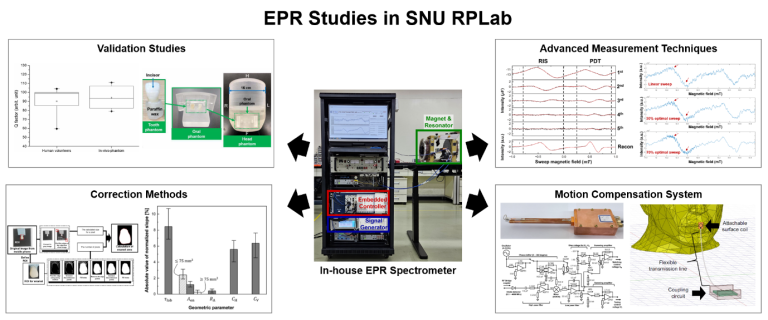
In vivo EPR tooth dosimetry was originally pioneered by Prof. Harold M. Swartz’s group at Dartmouth College. At SNU RPLab, we have constructed and advanced a homebuilt EPR spectrometer and have continued research on measurement techniques, motion compensation, correction methods, validation studies, and uncertainty analysis for in vivo tooth dosimetry. Representative research topics are summarized in the figure below.
This research has been supported by the Nuclear Safety and Security Commission (NSSC) and Korea Hydro & Nuclear Power Co., Ltd. (KHNP). We also maintain collaborative research with Prof. Hiroshi Hirata at Hokkaido University and Prof. Harold M. Swartz at the Dartmouth EPR Center.